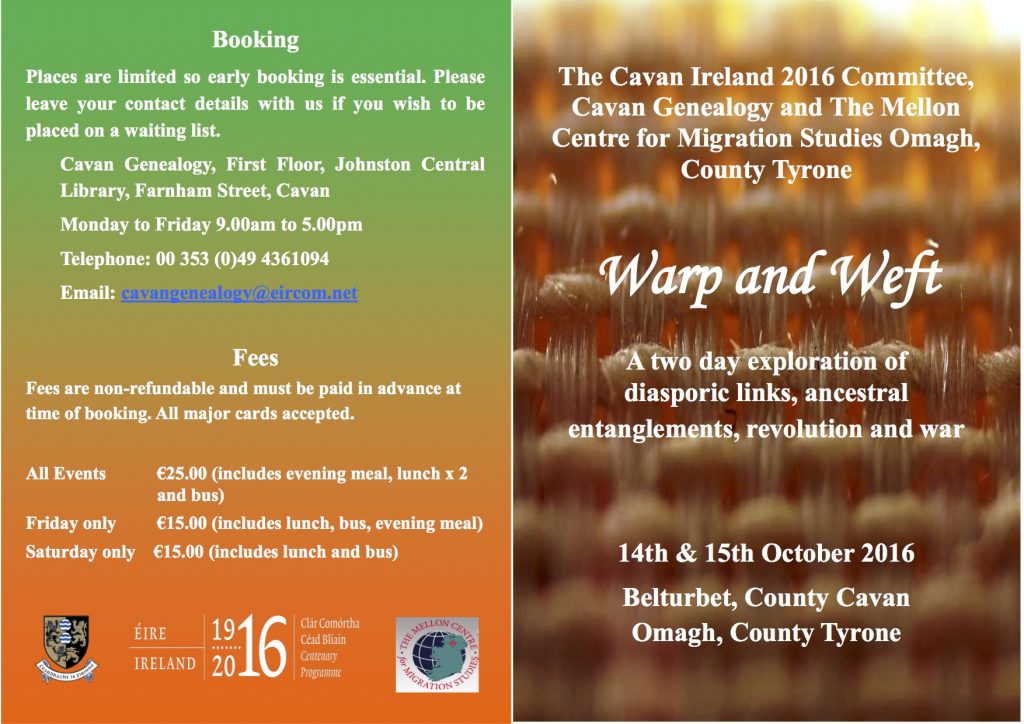
Warp and Weft – A two day exploration of diasporic links, ancestral entanglements, revolution and war
The Cavan Ireland 2016 Committee, Cavan Genealogy and The Mellon Centre for Migration Studies Omagh, County Tyrone
Warp and Weft – A two day exploration of diasporic links, ancestral entanglements, revolution and war
on 14th & 15th October 2016
Belturbet, County Cavan and Omagh, County Tyrone
Friday 14th October at Belturbet Library
10.30am Registration and Tea/Coffee
11.00am Professor Timothy G. Mc Mahon ‘Not Free Merely But Gaelic as Well’: South Ulster, the Diaspora and the Irish Revolution
12.20pm Lunch
1.30pm Bus to Kiltyclogher, County Leitrim
2.30pm Dr Gerard Mac Atasney Seán Mac Diarmada with visits to his birthplace, Kiltyclogher Heritage Centre and monument followed by Tea/Coffee
5.00pm Return for evening meal – The Seven Horseshoes, Belturbet at 6.30pm
8.00pm The Hacklers Drama Group present Rising Voices 8.45pm Discussion hosted by Frank Galligan
Saturday 15th October at MCMS at Ulster American Folk Park, Omagh
10.30am Tea/Coffee
11.00am Dr Patricia Craig A Twisted Root Ancestral Engagements in Ireland
12.30pm Lunch
1.30pm Exploring 1916 in the Ulster American Folk Park
2.30pm Dr Johanne Devlin Trew and Omagh Robins ‘Of Bicycles and Fallow Fields…’: Great War drama written and performed by Omagh Robins
4.00pm Close
Timothy G. McMahon is associate professor of history at Marquette University, Milwaukee, Wisconsin. His research includes national identity, imperialism and popular culture in modern Ireland and Britain. Included among his many publications are Grand Opportunity The Gaelic Revival and Irish Society, 1893 – 1910and the memoir Pádraig Ó Fathaigh’s War of Independence: Recollections of a Galway Gaelic Leaguer. He is co-editing a collection of essays Ireland’s Imperial Cultures, 1800 – 1950.
Dr Gerard Mac Atasney from Lurgan, County Armagh has written extensively on the history of County Leitrim, the home county of his mother. In 2004, Seán Mac Diarmada The Mind of the Revolution was the first book to be published about this largely neglected figure of the 1916 rising. Tom Clarke Life, Liberty, Revolution the first biography of Clarke since 1936 was published in 2013. The Dead Buried by the Dyeing The Great Famine in Leitrim is his most recent work
Derry born Frank Galligan with Cavan roots is a radio and TV host, newspaper columnist, poet, short story writer, writing trainer and festival and concert host. He taught creative writing at the University of Ulster and has been a long-time creative writing facilitator. Publications include a collection of short stories Out of The Blue and poetry collections A Strong Weakness and A Cold Forbidding Irish Green. His play Maria Live is a celebration of the life of Maria Edgeworth.
Dr Patricia Craig was born in Belfast, moved to London in the 1960s and returned to live in Northern Ireland in 1999. She has written biographies of Elizabeth Bowen and Brian Moore. Her memoir Asking for Trouble was published in 2007 and A Twisted Root: Ancestral Entanglements in Ireland, in 2012. An acclaimed literary critic and anthologist, she is the editor of many anthologies including The Oxford Book of Ireland, The Ulster Anthology and Penguin Book of British Comic Stories.
Dr Johanne Devlin Trew is a lecturer at the University of Ulster. She held research and teaching posts at Queen’s University Belfast, Memorial University, Newfoundland and Concordia University, Montreal. She has also been a research associate on several joint projects with the Mellon Centre for Migration Studies, Omagh. She is the author of two recent books: Leaving the North: Migration and Memory, Northern Ireland, 1921 – 2011 and Place, Culture and Community: The Irish Heritage of the Ottawa Valley.
Booking – Places are limited so early booking is essential. Please leave your contact details with us if you wish to be placed on a waiting list.
Cavan Genealogy, First Floor, Johnston Central Library, Farnham Street, Cavan
Monday to Friday 9.00am to 5.00pm
Telephone: 00 353 (0)49 4361094
Email: cavangenealogy@eircom.net
Fees
Fees are non-refundable and must be paid in advance at time of booking. All major cards accepted.
All Events €25.00 (includes evening meal,lunch x 2 and bus)
Friday only €15.00 (includes lunch and bus)
Saturday only €15.00 (includes lunch, bus, evening meal)
Books relating to the City and County of Derry-Londonderry Genealogy by Brian Mitchell
Books relating to the City and County of Derry-Londonderry Genealogy by Brian Mitchell are available from www.genealogical.com
Brian Mitchell has added two new volumes to his series on Derry-Londonderry genealogy. One covers the place names of county Derry, while the other offers a list of inhabitants extracted from the 1921 Derry Directory. These new books complement Mitchell’s 2014 works, Tracing Derry-Londonderry Roots and Derry Londonderry: Gateway to a New World. The Story of Emigration from the Foyle by Sail and Stream.
New! The Place Names of County Derry
The Place Names of County Derry consists of two parts. In Part One researchers will find a list of 1,750 place names, in alphabetical order, as recorded in the 1901 census returns for the city and county of Londonderry (also known as Derry). It includes the names of all townlands, together with street listings for all towns, in County Derry. Against each place name, i.e. townland or town and street, is recorded the following information: district electoral division, parish, registrar district, poor law union, and 17th-century landowner. Knowing the record jurisdictions for place names will result in more effective use of major Irish record sources such as 1901 and 1911 census returns; church registers; civil registers of births, marriages, and deaths; the national indexes to civil birth, marriage, and death registers; and estate records.
Part Two, County Derry Parish Reports, features record sources of value–both civil and church–to family historians, compiled and recorded by parish. Realistic genealogical research, in the absence of indexes and databases, generally requires knowledge of the parish in which your ancestor lived. This section details parish reports, in alphabetical order, for each of Derry’s 46 civil parishes, describing and locating the parish, identifying the top ten surnames in the mid-19th century, and detailing the major record sources for that parish.
New! The People of Derry City, 1921: Extracted from the “Derry Almanac and Directory”
Because the 1926 census for Northern Ireland was used for waste paper in World War II, the first census that survives since 1911 for the city and county of Londonderry is that of 1937, and this will be available for inspection in the year 2038 (unless the 100-year closure rule is waived before then). This means that each annual edition of the Derry Almanac is the closest surviving census document for Derry city in the period from 1912 to 1936.
This new publication by Irish genealogist Brian Mitchell lists inhabitants, in alphabetical order by surname, in Derry City in 1921. As transcribed here, the work contains five fields: surname of head of household, first name of head of household, street address, house number, and page number of the listing in the Derry Almanac. In all, the Derry Almanac and Directory of 1921 names 8,288 heads of household in Derry city.
Derry-Londonderry: Gateway to a New World. The Story of Emigration from the Foyle by Sail and Stream
The emigration trade established Derry as one of the chief Irish ports for the transatlantic trade in the 18th century. For example, in 1771 the American colonies took more linen cloth and provisions from Derry than Britain did, and 30 percent of Ulster-Scots, around 75,000 people, emigrated through Derry to North America prior to 1776. Brian Mitchell captures the protagonists and milestones of this history in his beautifully illustrated tribute to Derry-Londonderry’s place in emigration history. The author’s brief narrative explains Derry’s rise and ultimate decline as a port of embarkation, conveys century by century what people utilized the port, traces the changes in emigration from the age of sail to the age of steam, and draws attention to individuals like composer Stephen Foster’s great-grandfather, Alexander Foster, who sailed from Derry, and to vessels like the Adam Lodge, which sailed from Derry to Australia. Highlighting the book are numerous illustrations that flesh out the Derry story, including passenger notices, sample passenger lists, pictures and photographs of actual vessels and passengers–some of them quite moving–maps, and more.
Tracing Derry-Londonderry Roots
Tracing Derry-Londonderry Roots recounts Derry’s importance in Irish emigration and explains how it impacts genealogical research for the area. The introductory chapters discuss the fundamentals of genealogical research, such as reviewing family papers and gathering family reminiscences, before emphasizing the importance of place or locality in all of Irish research. In Derry’s case, this means ascertaining the name of the townland(s) your forebears came from in order to utilize the treasure trove of Irish records that can shed light on the people who lived there. The meat of the book consists of a review of the main record sources for Derry genealogy, including civil registers of births, marriages, and deaths; church registers of baptisms, marriages, and burials; gravestone inscriptions; wills; 1901 and 1911 census returns; mid-19th-century Griffith’s Valuation; early 19th-century Tithe Applotment Books; the 1831 census; and pre-1800 census substitutes. Brian Mitchell explains where you can find these sources (including Internet sources) before launching into a discussion of the main Irish record repositories for Derry ancestry research. He concludes with a detailed treatment of all the local record offices.
An exploration of the Fleming/Mackey family from Mullinakill, Co. Kilkenny
An exploration of the Fleming/Mackey family from Mullinakill, Co. Kilkenny, ancestors of Democratic US Vice-Presidential candidate, Senator Tim Kaine.
William Fleming leased agricultural land in the townland of Mullinakill per the Tithe Applotment Survey 1833 being ‘co-tenant of John Mackey.’ It appears that William had at least two sons William and John. The earliest entries in the Rosbercon Catholic register date from c. 1817.
William Fleming and Catherine Mackey lived in the townland of Mullinakill, in the civil parish of Jerpoint West encompassed by the Catholic parish of Rosbercon, Co. Kilkenny. Their marriage is not recorded which simply means that it has not survived. Many marriages took place in the house of the bride in past times, and was celebrated so well that it is possible that the event went unrecorded! Their origins in the townland are evidenced by a lease to Wm. Fleming of agricultural land in 1833. Census records do not survive so there is no other means of establishing this other than from available vital records of marriage and baptism
Baptisms recorded to them were:
Thomas, 30 Aug 1831
Mary, 25 Mar 1835
Richard, 27 Apr 1837
James, 26 May 1846
Evidently the family emigrated to Canada c. 1851 where their son Thomas Fleming married Elizabeth Downey who was born there but to Kilkenny parents who were married in St. Canice’s, Kilkenny – Patrick Downey and Elizabeth Phelan. Catherine Fleming, the daughter of Thomas and Elizabeth, born in Canada, married Patrick Farrell from Killashee, Co. Longford and their daughter Annabella married Tim Kaine’s grandfather.
It appears that William was a younger brother of John Fleming who married a year after William and his family left the country. John married a local girl Catherine Blanchfield on 23 March 1852 per Rosbercon parish register. The family lived in the Listerlin side of this Catholic parish. Their children were:
William, 26 January 1853
Catherine, 20 December 1855
Thomas, 11 February 1861
Edmond, 26 September 1868
The Griffith’s Valuation of 1850 and cancellations up to 1889 list John Fleming as lessee of 6 acres 1 rood 6 perches and 39 acres 1 rood 29 perches from Charles Putland at Mullinakill. The holdings passed to Catherine after John’s death and then passed to Edward c.1912. According to a local land survey taken up during the twentieth century the family farmed 62 acres of land at one time [John Kennedy was the surveyor].
William’s nephew and John’s son Edward Fleming married Bridget Malone of Glenpipe on 30 Jan 1907 in Rosbercon. Edward and Bridget’s children were:
John, 24 January 1908
James, 9 June 1909
Catherine, 1 September 1910
William, 1916
Edward’s daughter Catherine Fleming married Michael Conway 13 April 1942 in Rosbercon. Three daughters were born to them:
Bridget, died 24 July 1960
Mary, m. ? Frisby
Johanna, b. 10 April 1949 and m. ? O’Meara
Michael and Catherine, both now deceased, are buried in Listerlin graveyard with their daughter Bridget, Ml died 11/07/1955, Bridget 24/07/1960, Catherine 8/12/1984.
Mary Frisby lives locally; Johanna [Joan] O.Meara lives in Co. Tipperary.
Edward’s son John now deceased was a bachelor – presumed buried in Listerlin.
Edward’s son James (Jimmy) married Anastasia. The tombstone to both in Listerlin graveyard referred to Jimmy of Mullinakill and London probably emigrated for a time, died 26 Jan 1873, his widow died 18 June 1978. [No Children?]
Edward’s son William born 17 Jan 1916, married Mary ? and had one daughter Bridget who married ? Gilligan – all are interred in Listerlin.
Mary d. 17/11/1976, Wm. D 25/04/1987, Bridget 23/11/2010.
The Fleming land has passed out of the family and some of it is under forestry. Sadly, the original farmhouse is not accessible, although it is clearly visible, almost derelict, from Fleming’s Lane in Mullinakill. Edward or Ned as he was locally called seems to have been the last to live here. William built a bungalow now occupied by Noel Morrissey and his family.
The Fleming lands rose high above the locality offering spectacular views of the landscape especially on a bright sunny morning. Close by is St. Moling’s Well where the pattern is held each year in late August and the scenic views from here are wonderful. There are few traditional farmhouses houses in the general area but one is occupied by John Kennedy who graciously took me to the Fleming lands and explained the changes in land ownership over past years.
Several Mackey families were resident in the townland of Mullinakill c. 1830, 1850 and even later. There is one Mackey family there now, but since it cannot be ascertained if they are one and the same family as Catherine Mackey who married William Fleming, parents of Thomas, it was decided not to pursue the line at the moment. Certainly all surnames above were still present in the townland c. 1976 including one William Fleming a son of Edward and Bridget born in 1916. However, some forty years later it is evident that there have been more changes in land ownership.
Sources consulted in the compilation of this research:
www.rootsireland.ie
www.rootsweb.com
census.nationalarchives.ie
Tithe Applotment Books
Civil Births and Marriages – Courtesy of Registrar, County Clinic, Kilkenny.
Printed Book of Griffith’s Valuation Barony of Knocktopher 1850 Parish of Jerpont West.
Ms Cancelled Book Barony of Knocktopher Parish of Jerpoint West, Mullinakill townland 1860 – 1912.
Print out of ratepayers as at 1976 – Courtesy of staff at the Valuation Office Dublin.
Gravestone inscriptions in Listerlin graveyard.
Discussion and tour of locality with John Kennedy of Glenpipe, Tullogher 30/0702016.
Conversation with Joan O’Meara nee Conway 30072016.
by Mary Flood, Kilkenny Genealogy Service, Rothe House, Parliament St., Kilkenny
30/07/2016
Ballarat Benevolent Asylum
O’Keeffe Clan Gathering 2016
The O’KEEFFE CLAN GATHERING 2016 is a Worldwide international O’Keeffe Clan Gathering which will take place in Cork, IRELAND in September 2016.
A very exciting week-end is planned for 9th-11th September, with a very full programme of events organised. It promises to be weekend of discovery and fun while tracing the path of our ancestors in a relaxed atmosphere. It is recognised that the O’Keeffe name has evolved in many ways with emigration to the new lands over the past centuries, for example, O’ Keefe, Keffe, O’Kief, O Cuiv, O Caoimh, and Keefer to name a few. All are welcome to this event, it is a chance to meet family and friends and you will have a chance to make new friends. Come and taste our Sliabh Lurachra culture and enjoy our music, song, storytelling and dance. A Cead Mile Failte will be given to our international cousins.
Our programme of events is as follows:
PROGRAMME OF EVENTS: O’Keeffe Clan Gathering will be held on 9th-11th September 2016. Dromtarriffe Hall, Kanturk, Cork, Ireland.
Friday 9th will see the event opened by clan chieftain Dan Joe O’Keeffe. There will be entertainment by the local traditional group âButtons and Strings from Rathcoole. Maurice O Keeffe of Irish Life and Lore will also give a talk on O’Keeffes. On Saturday 10th historical exhibitions will be on show and genealogical advice offered to those wishing to trace ancestors. Presentations by irishlifeandlore.com. There will two guided bus tours to historical sites related to O’Keeffes.
On Saturday night we will be holding a full Banquet followed by entertainment of music, song, dance and storytelling by Ceoltoiri Sliabh Luachra in Wallis Arms Hotel, Millstreet. On Sunday we will be holding an O’Keeffe Memorial Mass at noon and following mass there will be a talk on Keeffe Coshe Mange by Lorna Moloney UCC Lecturer. The commemoration and closing ceremony will bring the weekend to a close.
Tours are costing 10 Euro each and the banquet is costing 30 Euro per person.
Bookings for banquet is essential through the following mobile numbers: 087-2547498 or 0868248537
This gathering promises to be a exciting and fascinating weekend of discovery for all.
See the website at
http://www.okeeffeclans.com/clangatheringrally.htmlfor full details
Reprinted books available from Ulster Historical Foundation
Old Families of Carrickfergus and Ballynure (Gravestone Inscriptions)
We are pleased to advise that the reprint of Old Families of Carrickfergus and Ballynure is now available. To order go to: www.booksireland.org.uk/store
Also available – Old Families of Larne and District (Gravestone Inscriptions, Co. Antrim Vol. 4)
To order a copy of Old Families of Larne and District go to: www.booksireland.org.uk/store
Irish Politics in Postcards (just published)
In case you missed it, the Foundation recently published a new book entitled Irish Politics in Postcards by Declan Martin. The publication examines how during the period of the early twentieth century, in particular, but also in later years, picture postcards were produced not only to illustrate Irish political events, but also through photographs and cartoons to influence or at least try to influence contemporary opinion. Illustrated with full colour images the book offers a quite exceptional selection of original postcards.
It is priced at only £17.99.
To order a copy please go to: www.booksireland.org.uk/store
Irish Politics in Postcards
To mark the release of Irish Politics in Postcards the Ulster Historical Foundation would like to offer an invite to the launch of this book. This event will take place on Friday, 24th June 2016 at 6:30pm (for 7:00pm) in the Discover Ulster-Scots Centre, 1-9 Victoria St, Belfast, Co. Antrim BT1 3GA.
Dr. Eamon Phoenix will be the guest speaker on the night and light refreshments will be provided.
Please RSVP to:
Ulster Historical Foundation
The Corn Exchange
31 Gordon Street
Belfast BT1 2LG
Tel: +44(0)28 9066 1988
E-mail: enquiry@uhf.org.uk
Please be advised that Irish Politics in Postcards is also now available to order from our online bookstore at: www.booksireland.org.uk
The exact origin of the picture postcard is in dispute but all who have taken an interest in the topic would be in agreement that they date from the latter part of the nineteenth century. What would also be beyond dispute is the era in which they first flourished in Britain and Ireland. That phenomenon can largely be attributed to a decision of the Post Office in 1894, that henceforth, it would accept for delivery cards with pictures. Prior to this, plain cards only, had been accepted by the postal authorities.
Even the plain cards had already proved their popularity, for in their first year of production (1870-71), sales figures had reached 75,000,000. The introduction of pictures further stimulated demand, and yet a further surge was brought about by an Act of Parliament in 1902, which for a charge of a 1/2d (halfpenny), allowed the sender to include both the address and a message on the reverse, thus leaving the whole of the front available for a picture. This new concession helped usher in a golden age of postcards, which lasted for about a quarter of a century. at the peak of their popularity, about 800,000,000 postcards were being posted per year.
Soldiers of the Short Grass – A History of the Curragh Camp by Dan Harvey
Soldiers of the Short Grass – A History of the Curragh Camp by Dan Harvey
This book will be launched on Wednesday, June 15 at 6.00 p.m. in Ceannt Officers’ Mess, Curragh Camp, Co. Kildare.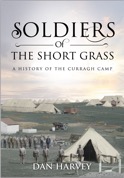
• The first complete history of this national landmark from 1855 to the present day, taking into account every facet of its development.
• The Curragh Camp had enormous implications for the outcome of Easter Week 1916 and the War of Independence.
• The story of the Curragh Camp is inextricably linked to the development of the Irish Defence Forces, which in turn is crucial to the history of Ireland.
Description: This is the first complete history of the Curragh Camp, from its foundation in 1855 to the present day, under both British and Irish occupation. Dan Harvey, a military historian and an experienced senior officer, presents a compelling and fascinating narrative of the camp’s many evocative eras and episodes. This unique establishment has been key in shaping Irish history while being shaped in turn by the great national and international conflicts that it was founded to respond to: the Crimean War, the Boer War, the Great War, the Easter Rising and War of Independence are all accounted for under the banner of the British Army. The first tricolour hoisted overhead of the camp signalled no change to its level of service as the Curragh’s forces were quickly embroiled in the Irish Civil War, later oversaw the years of the modern Troubles and forged an international role with the Irish Defence Forces.
These grand narratives are interlaced with smaller yet significant tales that personalise the institution and lend vitality to the many facets that keep service, work and a livelihood in check on world-renowned plains once covered by ‘St. Brigid’s cloak’. Prince Edward’s royal visit and training, and the ‘Wrens’ less welcome visits to the soldiers after dark – everyday and extraordinary matters are described to give the most authoritative history, compelling and meticulously written, of a camp inextricable to Ireland for over one hundred and fifty years.
About the Author: Lieutenant Colonel Dan Harvey has served on operations at home and abroad for over thirty-five years to date. He has previously written about major incidents involving Irish Defence Force members on active overseas peacekeeping service, including Peace Enforcers: The EU Intervention in Chad, and Peacekeepers: Irish Soldiers in the Lebanon.
For press and publicity enquiries contact Peter O’Connell + 353 87 681 4499 peter@peteroconnellmedia.com Merrion Press, 10 George’s Street, Newbridge, Co. Kildare +353 45 432497 www.merrionpress.ie
Searching Roscommon newspapers
The following newspapers have been digitized and are available to search online at all libraries in County Roscommon.
Roscommon Papers
Roscommon Champion (1944-2009)
Roscommon Herald (1882-2013)
Roscommon Journal (1828-1927)
Roscommon Messenger (1848-1935)
Roscommon and Leitrim Gazette (1822-1882)
Strokestown Democrat (1913-1948)
Regional Papers
Connacht Sentinel (1927-current)
Connacht Tribune (1909-current)
Connacht Telegraph (1900-current)
Leitrim Observer (1904-current)
Longford Leader (1897-current)
National Papers
Freeman’s Journal (1763-1924)
Irish Press (1931-1995)
Irish Independent (1905-current)
The Nation (1842-1897)
Sunday Independent (1906-current)
They also hold a number of local newspapers on microfilm:
Athlone News (1961–1962)
Athlone Observer (1985–1995)
Athlone Times (1887–1889)
Longford Independent (1885–1925)
The Nation (1842–1897)
Roscommon and Leitrim Gazette (1822–1872)
Roscommon Champion (1944–2009)
Roscommon Constitutionalist (1889–1891)
Roscommon Herald (1859–2012)
Roscommon Journal and Western Reporter (1828–1927)
Roscommon Messenger (1848–1935)
Roscommon People (2006–2012)
Roscommon Reporter (1850–1860)
Strokestown Democrat (1913–1948)
Western Nationalist (1907–1920)
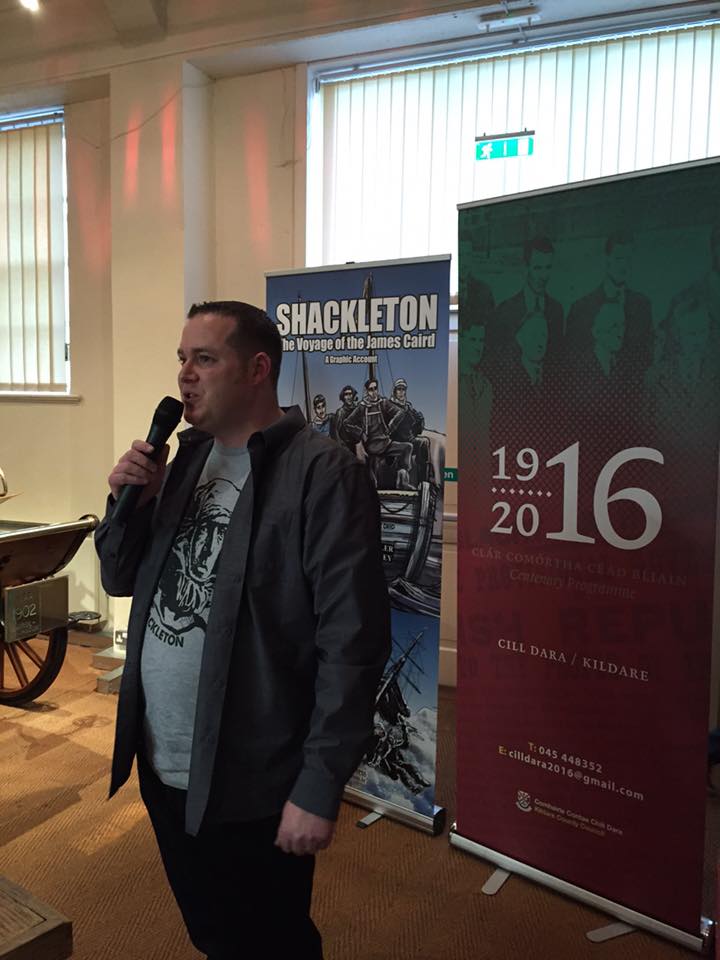
Shackleton – The Voyage of the James Caird. A Graphic Account
Shackleton – The Voyage of the James Caird. A Graphic Account. Written by Gavin McCumiskey. Illustrated by David Butler.
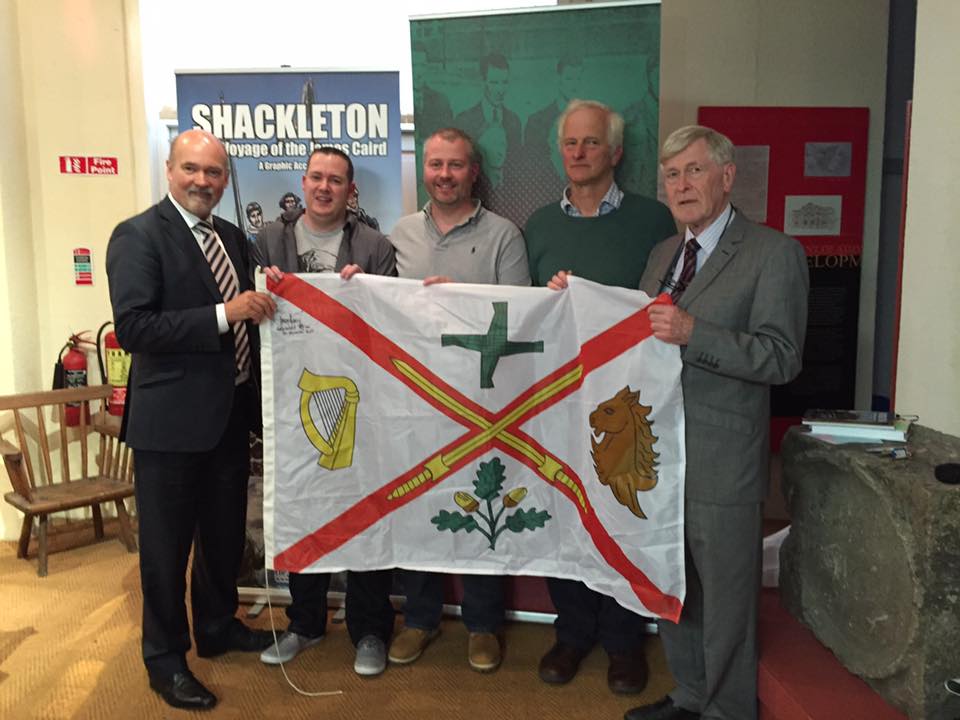
This new publication was launched last night in the Athy Heritage Centre by Jonathan Shackleton, a cousin of Ernest Shackleton. He also presented the Kildare County flag which he brought on a recent trip to the South Pole to the centre where it will be displayed.
When the mighty Endurance becomes trapped in the Weddell Sea, Ernest Shackleton’s dream to cross the Antarctic becomes a fight to save the twenty-seven souls that set sail with him. With five others, he takes to the sea in the lifeboat, James Caird, and sets a course for South Georgia, 800 miles away across treacherous waters. This graphic depiction brings to life the ceaseless struggle against the harshest environment on Earth, and culminates in the most dramatic real-life open-boat journey in the history of mankind. It is the first illustrated retelling of the greatest feat of leadership and survival ever recorded.
Curious about what goes into creating a graphic novel? Illustrator David Butler put together this video about creating the cover of his book.www.youtube.com/watch?v=Va2IcuujfbY
- « Previous Page
- 1
- …
- 8
- 9
- 10
- 11
- 12
- …
- 16
- Next Page »