Ballarat Benevolent Asylum
O’Keeffe Clan Gathering 2016
The O’KEEFFE CLAN GATHERING 2016 is a Worldwide international O’Keeffe Clan Gathering which will take place in Cork, IRELAND in September 2016.
A very exciting week-end is planned for 9th-11th September, with a very full programme of events organised. It promises to be weekend of discovery and fun while tracing the path of our ancestors in a relaxed atmosphere. It is recognised that the O’Keeffe name has evolved in many ways with emigration to the new lands over the past centuries, for example, O’ Keefe, Keffe, O’Kief, O Cuiv, O Caoimh, and Keefer to name a few. All are welcome to this event, it is a chance to meet family and friends and you will have a chance to make new friends. Come and taste our Sliabh Lurachra culture and enjoy our music, song, storytelling and dance. A Cead Mile Failte will be given to our international cousins.
Our programme of events is as follows:
PROGRAMME OF EVENTS: O’Keeffe Clan Gathering will be held on 9th-11th September 2016. Dromtarriffe Hall, Kanturk, Cork, Ireland.
Friday 9th will see the event opened by clan chieftain Dan Joe O’Keeffe. There will be entertainment by the local traditional group âButtons and Strings from Rathcoole. Maurice O Keeffe of Irish Life and Lore will also give a talk on O’Keeffes. On Saturday 10th historical exhibitions will be on show and genealogical advice offered to those wishing to trace ancestors. Presentations by irishlifeandlore.com. There will two guided bus tours to historical sites related to O’Keeffes.
On Saturday night we will be holding a full Banquet followed by entertainment of music, song, dance and storytelling by Ceoltoiri Sliabh Luachra in Wallis Arms Hotel, Millstreet. On Sunday we will be holding an O’Keeffe Memorial Mass at noon and following mass there will be a talk on Keeffe Coshe Mange by Lorna Moloney UCC Lecturer. The commemoration and closing ceremony will bring the weekend to a close.
Tours are costing 10 Euro each and the banquet is costing 30 Euro per person.
Bookings for banquet is essential through the following mobile numbers: 087-2547498 or 0868248537
This gathering promises to be a exciting and fascinating weekend of discovery for all.
See the website at
http://www.okeeffeclans.com/clangatheringrally.htmlfor full details
Reprinted books available from Ulster Historical Foundation
Old Families of Carrickfergus and Ballynure (Gravestone Inscriptions)
We are pleased to advise that the reprint of Old Families of Carrickfergus and Ballynure is now available. To order go to: www.booksireland.org.uk/store
Also available – Old Families of Larne and District (Gravestone Inscriptions, Co. Antrim Vol. 4)
To order a copy of Old Families of Larne and District go to: www.booksireland.org.uk/store
Irish Politics in Postcards (just published)
In case you missed it, the Foundation recently published a new book entitled Irish Politics in Postcards by Declan Martin. The publication examines how during the period of the early twentieth century, in particular, but also in later years, picture postcards were produced not only to illustrate Irish political events, but also through photographs and cartoons to influence or at least try to influence contemporary opinion. Illustrated with full colour images the book offers a quite exceptional selection of original postcards.
It is priced at only £17.99.
To order a copy please go to: www.booksireland.org.uk/store
Irish Politics in Postcards
To mark the release of Irish Politics in Postcards the Ulster Historical Foundation would like to offer an invite to the launch of this book. This event will take place on Friday, 24th June 2016 at 6:30pm (for 7:00pm) in the Discover Ulster-Scots Centre, 1-9 Victoria St, Belfast, Co. Antrim BT1 3GA.
Dr. Eamon Phoenix will be the guest speaker on the night and light refreshments will be provided.
Please RSVP to:
Ulster Historical Foundation
The Corn Exchange
31 Gordon Street
Belfast BT1 2LG
Tel: +44(0)28 9066 1988
E-mail: enquiry@uhf.org.uk
Please be advised that Irish Politics in Postcards is also now available to order from our online bookstore at: www.booksireland.org.uk
The exact origin of the picture postcard is in dispute but all who have taken an interest in the topic would be in agreement that they date from the latter part of the nineteenth century. What would also be beyond dispute is the era in which they first flourished in Britain and Ireland. That phenomenon can largely be attributed to a decision of the Post Office in 1894, that henceforth, it would accept for delivery cards with pictures. Prior to this, plain cards only, had been accepted by the postal authorities.
Even the plain cards had already proved their popularity, for in their first year of production (1870-71), sales figures had reached 75,000,000. The introduction of pictures further stimulated demand, and yet a further surge was brought about by an Act of Parliament in 1902, which for a charge of a 1/2d (halfpenny), allowed the sender to include both the address and a message on the reverse, thus leaving the whole of the front available for a picture. This new concession helped usher in a golden age of postcards, which lasted for about a quarter of a century. at the peak of their popularity, about 800,000,000 postcards were being posted per year.
Soldiers of the Short Grass – A History of the Curragh Camp by Dan Harvey
Soldiers of the Short Grass – A History of the Curragh Camp by Dan Harvey
This book will be launched on Wednesday, June 15 at 6.00 p.m. in Ceannt Officers’ Mess, Curragh Camp, Co. Kildare.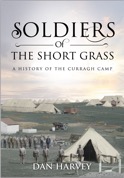
• The first complete history of this national landmark from 1855 to the present day, taking into account every facet of its development.
• The Curragh Camp had enormous implications for the outcome of Easter Week 1916 and the War of Independence.
• The story of the Curragh Camp is inextricably linked to the development of the Irish Defence Forces, which in turn is crucial to the history of Ireland.
Description: This is the first complete history of the Curragh Camp, from its foundation in 1855 to the present day, under both British and Irish occupation. Dan Harvey, a military historian and an experienced senior officer, presents a compelling and fascinating narrative of the camp’s many evocative eras and episodes. This unique establishment has been key in shaping Irish history while being shaped in turn by the great national and international conflicts that it was founded to respond to: the Crimean War, the Boer War, the Great War, the Easter Rising and War of Independence are all accounted for under the banner of the British Army. The first tricolour hoisted overhead of the camp signalled no change to its level of service as the Curragh’s forces were quickly embroiled in the Irish Civil War, later oversaw the years of the modern Troubles and forged an international role with the Irish Defence Forces.
These grand narratives are interlaced with smaller yet significant tales that personalise the institution and lend vitality to the many facets that keep service, work and a livelihood in check on world-renowned plains once covered by ‘St. Brigid’s cloak’. Prince Edward’s royal visit and training, and the ‘Wrens’ less welcome visits to the soldiers after dark – everyday and extraordinary matters are described to give the most authoritative history, compelling and meticulously written, of a camp inextricable to Ireland for over one hundred and fifty years.
About the Author: Lieutenant Colonel Dan Harvey has served on operations at home and abroad for over thirty-five years to date. He has previously written about major incidents involving Irish Defence Force members on active overseas peacekeeping service, including Peace Enforcers: The EU Intervention in Chad, and Peacekeepers: Irish Soldiers in the Lebanon.
For press and publicity enquiries contact Peter O’Connell + 353 87 681 4499 peter@peteroconnellmedia.com Merrion Press, 10 George’s Street, Newbridge, Co. Kildare +353 45 432497 www.merrionpress.ie
Shackleton – The Voyage of the James Caird. A Graphic Account
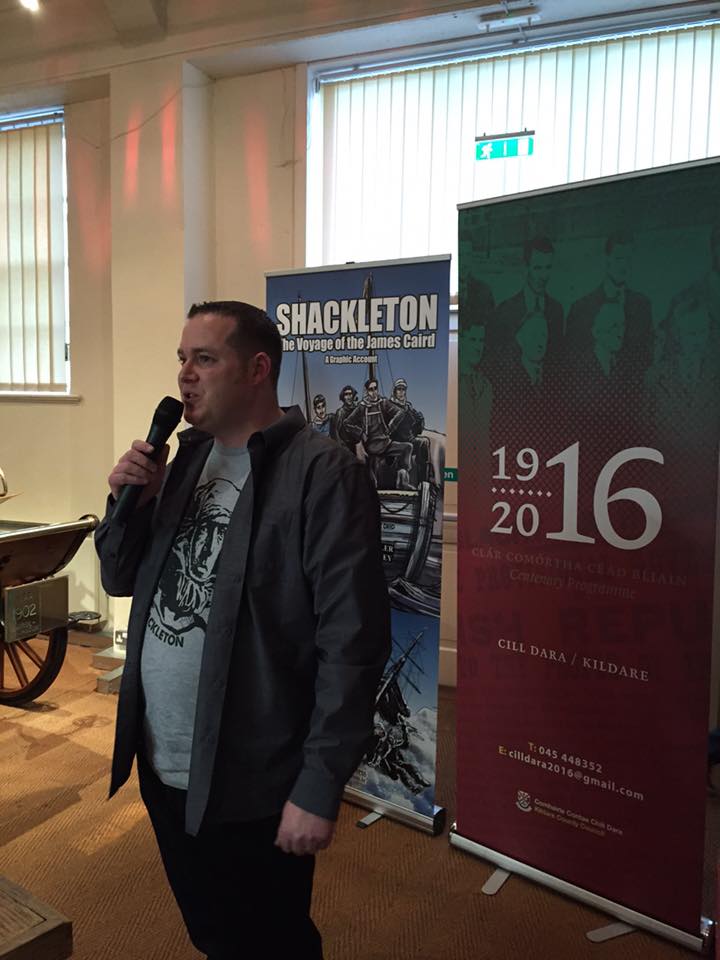
Shackleton – The Voyage of the James Caird. A Graphic Account. Written by Gavin McCumiskey. Illustrated by David Butler.
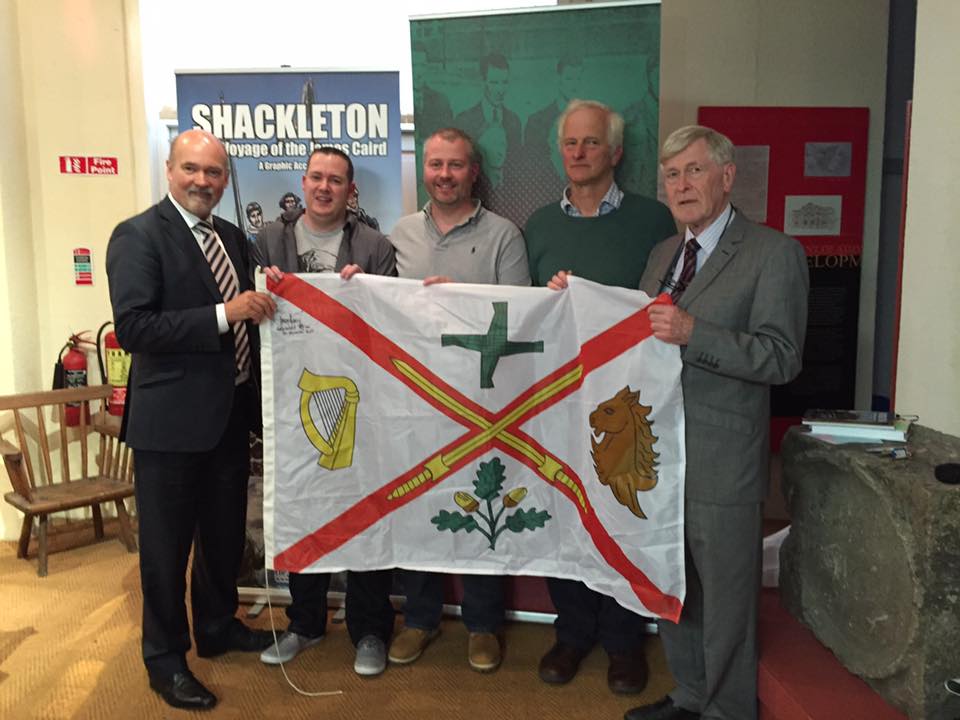
This new publication was launched last night in the Athy Heritage Centre by Jonathan Shackleton, a cousin of Ernest Shackleton. He also presented the Kildare County flag which he brought on a recent trip to the South Pole to the centre where it will be displayed.
When the mighty Endurance becomes trapped in the Weddell Sea, Ernest Shackleton’s dream to cross the Antarctic becomes a fight to save the twenty-seven souls that set sail with him. With five others, he takes to the sea in the lifeboat, James Caird, and sets a course for South Georgia, 800 miles away across treacherous waters. This graphic depiction brings to life the ceaseless struggle against the harshest environment on Earth, and culminates in the most dramatic real-life open-boat journey in the history of mankind. It is the first illustrated retelling of the greatest feat of leadership and survival ever recorded.
Curious about what goes into creating a graphic novel? Illustrator David Butler put together this video about creating the cover of his book.www.youtube.com/watch?v=Va2IcuujfbY
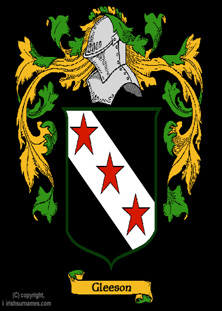
Gleeson Clan Gathering 19-24 August, 2016
The Gleeson Clan Gathering will take place on 19-24h August 2016. A variety of lectures, tours, and excursions have been arranged for each day. The Gleeson Clan Gathering starts in Nenagh, moving to Silvermines, Dolla and Thurles, all in County Tipperary, Ireland. The Gathering has already generated a huge amount of interest both locally and internationally from Gleesons and non-Gleesons alike, but everyone is welcome to attend. Thanks to the incredible generosity of local people, most of the events and activities are completely free.
If you have any questions, simply email. There is an ‘Early Bird’ offer so make your reservation today! For further information visit our blog at: http:/gleesongathering.blogspot.ie Email:gleesonclan2016@gmail.com
Aspects of Dun Laoghaire Rathdown at the time of the Rising 1916
Some 1916 connections with Dun Laoghaire Rathdown are explored by Catherine Malone.
You can contact Catherine, of the Dun Laoghaire Rathdown Heritage & Genealogy Centre at cmalone@dlrcoco.ie The Dun Laoghaire Rathdown Centenery Programme of Events can be found at www.ireland.ie
In 1916 Kingstown (now Dun Laoghaire) still wore the mantle of a prosperous Victorian town, with elegant squares, rows of fine terraced houses, mansions and private villas dotted throughout the region. Many of the inhabitants of the houses were successful merchants and entrepreneurs. The more modest homes were those of working class families who were mainly employed in building work or in the local stone quarries. The 1901 Census recorded a large proportion of local men and women were employed as gardeners and domestic servants in the big houses.
As a busy maritime port with major commercial, mail and passenger services the town received a steady flow of visitors. An added attraction was the annual regatta, an event that attracted visitors and yachting enthusiasts from all over the yachting world. This celebrated event was hosted by the Royal St. George, one of the more exclusive yachting clubs that border the harbour.
The population, who were mainly Protestant, were devoted to maintaining the bond with England. Some nationalists were content with the promised Home Rule, already on the statute books, improved economic conditions and reforms that saw some Catholics reaching middle class status. However, a small body of nationalists believed that Home Rule did not go far enough, and the only way to an independent Ireland was through rebellion.
Rebellion 1916
Over 170 people from Dun Laoghaire and environs took part in the Easter Rising. Among them were some of the leaders who were born in or associated with the area prior to 1916.
Padraig Pearse (1879-1916) was born in Dublin. Founder of St. Enda’s School (Scoil Éanna) in Cullenswood House in Ranelagh, a suburb of County Dublin, in 1908. The pupils were taught in both Irish and English. Two years later the school moved to The Hermitage in Rathfarnham, County Dublin, now home to the Pearse Museum. William Pearse, brother of Padraic, along with Thomas MacDonagh and Joseph Plunkett, all prominent in the Rising, were teachers at St. Enda’s.
Pearse was dedicated to the revival of the Irish language and the school became an important centre for the Irish language movement in Dublin. He became an early member of the Irish Volunteer Force where his talent as an orator brought him to the attention of the Irish Republican Brotherhood, a secret oath-bound society founded in the U.S.A. He subsequently became a member of the Military Council, the inner circle who planned the Rising.
On Easter Monday 1916, Pearse stood outside the General Post Office, Sackville Street, (now O’Connell Street) Dublin, and read the Proclamation of the Irish Republic to a small gathering, unsure of what was happening. The document, fresh off the press, was signed by six other members of the military force – Thomas J. Clarke, Sean MacDiarmada, James Connelly, Thomas MacDonagh, Eamonn Ceannt and Joseph Plunkett. The long awaited insurrection was now a reality.
Sir Roger Casement (1864-1916) born in Doyle’s Cottage, Sandycove, Co. Dublin. He worked for the British Consular Service where he received an knighthood for his work in the Belgian Congo. He later became disillusioned by the British establishment, and returned to Ireland offering his services to the Irish cause. He travelled to Germany as envoy for Ireland, seeking support and military aid for the forthcoming rebellion.
On 10 April 1916, the German cargo ship, the Aud, left the port of Lubeck with a shipload of rifles bound for Ireland. However, the plan was foiled; as the ship neared Tralee Bay, Co. Kerry, there was no response to the agreed signal of a flashing light. The Aud had no alternative but to leave Irish waters. Casement, travelling by submarine U19, bound for Banna Strand, Co. Kerry, was later arrested and sent to England to await trial. He was found guilty and sentenced to death for high treason. He was excuted on 3 August, 1916.
Eamon De Valera (1882-1975) born in New York, U.S.A. Gaelic scholar and avid supporter of the Irish language movement in Dublin. He was educated at Blackrock College, Co. Dublin, excelling in the subjects of Irish and mathematics He subsequently become professor of mathematics at the Teachers’ Training College, Glasthule, Co. Dublin, where he remained up to 1916.
As a member of the Irish Volunteer Force, he led the Second Battalion at Boland’s Mill, a large bakery overlooking the main road from the port of Dun Laoghaire to the city. This was a strategic position, as over two thousand British troops had set up camp there awaiting orders to march into the city. De Valera, was the last to leave his post following news of surrender. He was reprieved from execution because of his US nationality and went on to become Taoiseach and later President of Ireland.
Countess Markievicz (1868-1927) Born Constance Gore-Booth in London into a family of wealth and title, she and her sister Eva were brought up in the genteel manner appropriate to the upper classes at that time. Constance was popular in both English and Irish society where she was befriended by William B. Yeats and Maud Gonne. Following her marriage to the Polish Count, Casimir Markievicz, she returned to Ireland. Her admiration for Jim Larkin, an Irish patriot, and his passionate oratory in support of the working classes, inspired her interest in nationalism. She became a member of Sinn Fein; in 1909 she co-founded Na Fianna, an Irish boy scout movement which she also funded.
She bought a small cottage in Sandyford, Co. Dublin, at the foot of the Dublin mountains. Here she lived on and off, initially pursuing her hobbies of painting and walking; however, the cottage and surroundings environs became the perfect training camp for the boy scouts, many of whom went on to join the volunteer force that fought at her side during the Rising. Markievicz, was posted as second in command at St. Stephen’s Green Garrison because of her ability with firearms. The garrison saw little action, as the main focus was on Mount St. Bridge and the city centre. After her capture she avoided execution because of her gender. See more about her cottage at https://fiannaeireannhistory.wordpress.com/2014/01/14/wm_2235-jpg/
Patrick Moran (1888-1921) born in Crossna, Co. Roscommon. Patrick Moran lived and worked in Blackrock and Dun Laoghaire, Co. Dublin, prior to the 1916 Rebellion. A labour activist and strong supporter of the nationalist cause, he was sworn into the secret association of the Irish Republican Brotherhood, and subsequently became part of the volunteer force stationed at Jacob’s Biscuit Factory during the Rising. Following the orders to surrender, he was arrested by the British and sent to a number of prisons in England, and Wales. Although Moran avoided execution in 1916 he was later tried and sentenced to death by hanging for the alleged shooting of a British soldier. He was executed in March 1921 despite evidence of his innocence.
Major John MacBride (1868-1916) born in Westport, Co Mayo. In the late 1800s MacBride emigrated to South Africa where he became a soldier of note, fighting against the British in the Boar War. On Easter Monday he left his home in Spencer Villas, Glasthule, Co. Dublin to go into the city. He was unaware of the imminence of the Rising until he reached Sackville Street.
Because of his past military experience he volunteered his services and was immediately posted as second in command at Jacob’s Biscuit Factory, Bishop Street, Dublin. Following his capture at the end of the Rising, he was tried and sentenced to death.
New Records Online for Fingal/North Dublin Genealogy Centre
New Records Online for Fingal/North Dublin Genealogy Centre
Fingal/North Dublin Genealogy Centre has added over 30,000 new records to its online database at Dublin North The new records include St. Margaret’s RC baptisms and marriages, county council interments, many new marriage records for Skerries, Balbriggan, Rush and Lusk, as well as various other additions and updates to all of its databases.
The full list of available sources for the Fingal/North Dublin Genealogy centre can be viewed at Dublin North
New publications for Derry researchers
Two new books by Brian Mitchell, the genealogist with Derry City and Strabane District Council, are now available. The Derry genealogy service is part of the Irish Family History Foundation and you can find out more about the service at www.rootsireland.ie/derry-genealogy
The People of Derry City, 1921: Extracted from the Derry Almanac and Directory available via www.genealogical.com
This publication by Irish genealogist Brian Mitchell lists inhabitants, in alphabetical order by surname, in Derry city in 1921. As transcribed here, the work contains five fields: Surname of Head of Household, First Name of Head of Household, Street Address, House Number, and Page Number of the listing in the Derry Almanac. In all, the Derry Almanac and directory of 1921 name 8,288 heads of household in Derry city.
Especially significant about the 1921 directory for Derry researchers are its references to Derry inhabitants amidst the turmoil of (1) the June 1920 six-day “civil war” between Nationalist and Unionist supporters in Derry city, which left 23 people dead and many wounded, and (2) the subsequent Irish War of Independence and Anglo-Irish Treaty, from 21 January 1919 to 6 December 1921. In effect, this work from Brian Mitchell is the closest thing we have to a census for Derry during this period of upheaval.
The Place Names of County Derry
Available via www.genealogical.com – The Place Names of County Derry
The Place Names of County Derry consists of two parts. In Part One researchers will find a list of 1,750 place names, in alphabetical order, as recorded in the 1901 census returns for the city and county of Londonderry (also known as Derry). Part Two, County Derry Parish Reports, features record sources–both civil and church–of value to family historians, compiled and recorded by parish.
- « Previous Page
- 1
- …
- 28
- 29
- 30
- 31
- 32
- …
- 35
- Next Page »